


How to Dress Actors in Vintage: A Complete Designer's Guide

A single anachronistic detail can shatter the illusion an entire production team has worked months to create. Imagine a beautifully dressed 1950s kitchen scene, and then the camera lingers on a zip with a modern nylon pull, or an actress moves and reveals a clearly contemporary bra strap beneath a supposedly authentic blouse. Balancing actor comfort and mobility with historical accuracy is one of the classic and enduring challenges facing every costume designer working in period drama. This guide walks you through exactly how to get it right, from the very first research session to final dress rehearsal, with practical steps and hard-won advice along the way.
Dressing Actors in Vintage: Table of Contents
Key Takeaways
Point | Details |
Sourcing preparation | Gathering correct measurements, identifying character needs, and researching the era are essential before seeking costumes. |
Vintage versus recreation | Recreated pieces are often ideal for high-use or demanding performances to balance authenticity and durability. |
Authentic finishing | Aging and distressing costumes can make modern garments blend into any period production. |
Fitting and safety | Always choose comfort and movement flexibility, even if that means a subtle compromise in historical accuracy. |
Designer’s choice matters | Storytelling and performance impact should always guide costuming decisions, not just authenticity. |
What You Need Before You Start
Before you start dressing actors in vintage, it’s essential to gather your materials and research. Rushing straight to sourcing is one of the most common and costly mistakes you can make. The preparation stage shapes every subsequent decision.

Start by building a thorough character bible. This means understanding not just the decade, but the specific year, the character’s social class, occupation, geographical location, and emotional arc. A working-class woman in 1964 Liverpool dressed very differently from a wealthy socialite in the same city that same year. Both require different silhouettes, fabric weights, and colour palettes. The devil is always in the detail.
Next, catalogue the actor’s every measurement. This goes beyond a standard chest, waist, and hip measurement. You need to note posture, shoulder slope, height in character shoes, and any particular mobility requirements. An actor performing eight shows a week in a corsetted bodice needs that garment to breathe and flex in ways a single film scene might not demand.
Here is a quick reference table to help structure your preparation:
Preparation element | Tools and sources | Priority level |
Period research | Fashion archives, museum collections, film stills | Essential |
Character backstory | Script, director’s notes, character breakdowns | Essential |
Actor measurements and mobility | Fitting sessions, movement workshops | Essential |
Budget allocation | Production budget sheet, sourcing estimates | High |
Garment condition assessment | Condition reports, vintage specialist input | High |
Reference imagery | Period photography, illustrated magazines, paintings | High |
Safety and stunt requirements | Stunt coordinator notes, health and safety reports | Critical |
When it comes to sourcing, you broadly have two choices: true vintage pieces or high-quality recreations. True vintage brings irreplaceable authenticity; the texture, cut, and weight of a genuine 1940s wool suit simply cannot be perfectly replicated. But authenticity comes with risk. Fragile seams, delicate fabrics, and non-standard sizing can make genuine vintage impractical for demanding productions. Houses like Cosprop supply Oscar-winning films and frequently rely on recreation for high-scrutiny productions, precisely because condition and consistency matter so much.
Our own costume sourcing guide is a useful starting point if you are new to building a vintage wardrobe for production, and our vintage sourcing tips article covers the specialist knowledge you need when approaching dealers and collections.
Pro Tip: Build a mood board for each character before you touch a single garment. Pin reference images from the exact era, including everyday street photography, not just glamour shots, so you capture how ordinary people actually dressed rather than how they were aspirationally portrayed.
Key preparation essentials to keep in mind:
Research the period using primary sources such as newspapers, catalogues, and period film stills rather than relying solely on secondary interpretations
Confirm all actor mobility requirements with the director and movement coach before the first fitting
Set aside at least 10 to 15 per cent of your costume budget for alterations and repairs
Identify any garments that will be worn in water, near flames, or during stunts before sourcing begins
Step-by-Step: Sourcing and Selecting Vintage Looks
With your essentials assembled, you can now begin the hands-on work of sourcing and vetting garments. This is where the real joy of the process lies, especially if you have a genuine passion for the periods you are working in.
Step 1: Identify reputable vintage suppliers. Not all vintage sellers understand the specific demands of production work. Look for dealers who can provide detailed provenance, accurate condition reports, and multiple garment options within a single reference era. Specialist platforms and curated online retailers often carry better catalogued stock than general markets.
Step 2: Request or visit in person. Where possible, handle garments before committing. Photographs rarely capture the true weight or handle of a fabric. For online sourcing, ask for detailed close-up images of seams, fastenings, fabric weave, and any areas of wear or repair.
Step 3: Assess condition rigorously. Check seam allowances (crucial if you need to let out for larger actors), underarm wear, lining condition, and the integrity of any original fastenings. Vintage buttons, hooks, and press studs are often irreplaceable.
Step 4: Cross-reference against your reference imagery. A garment might be from the correct decade but wrong in silhouette for your character. An early 1960s A-line skirt reads very differently from a late 1960s mini. Precision matters here.
Step 5: Decide: original, altered, or recreated? Recreation is often preferred for high-profile projects where accuracy and condition must be flawless. For the Michael Jackson biopic, for example, the costume team worked from original archive pieces but created wearable versions to withstand performance demands.
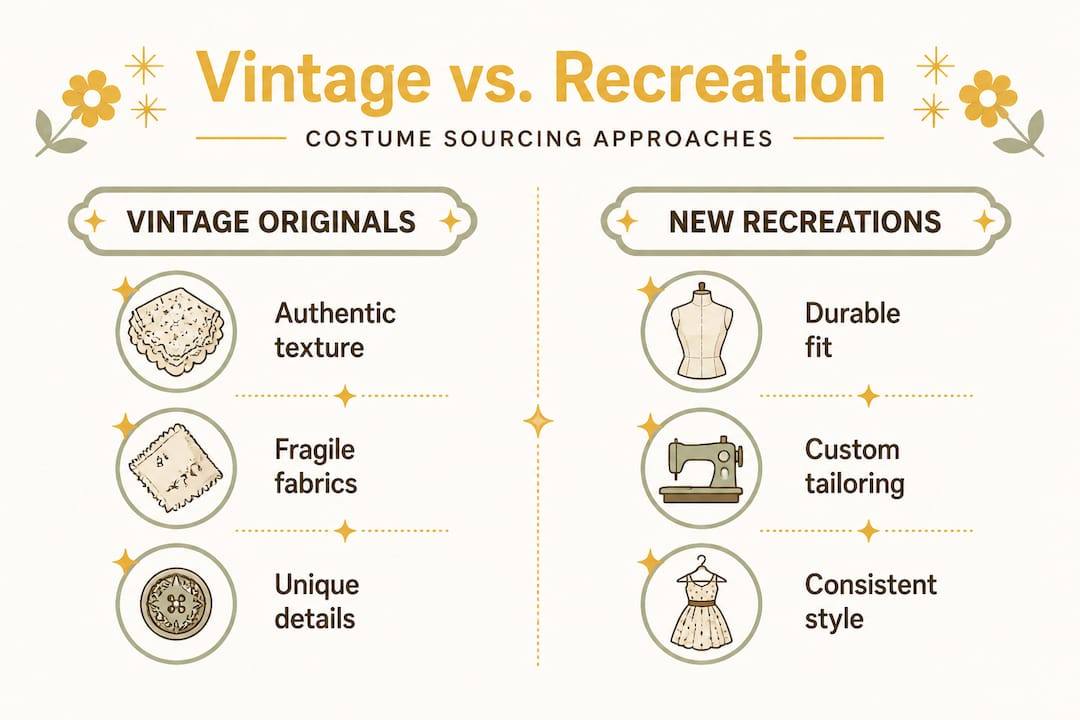
Here is a quick comparison to guide your decision:
Approach | Pros | Cons | Best for |
True vintage | Unmatched authenticity, texture | Fragile, limited sizes, irreplaceable if damaged | Low-movement scenes, close-ups |
Altered vintage | Good authenticity, adapted fit | Risk of damage, limited alteration scope | Moderate performance demands |
Quality recreation | Durable, custom-fit, replicable | Requires skilled makers, higher upfront cost | Stunts, repeat performances, exacting fit |
Our article on vintage costume essentials goes deeper into building a core wardrobe for different eras, and if you want to see what exceptional period pieces look like in practice, our round-up of iconic vintage fashion moments in film history is genuinely inspiring reading.
Pro Tip: When sourcing online, search using era-specific terminology rather than broad decade labels. Try “New Look silhouette 1951” or “mod shift dress 1966” rather than simply “1950s dress” or “1960s fashion” to find more accurate pieces faster.
Keep an eye on our new vintage arrivals if you are actively building a production wardrobe, as fresh stock comes in regularly and production-worthy pieces move quickly.
Making Costumes Look Authentically Worn
Once outfits are sourced, they often need further work to fit the production’s vision for authenticity. A pristine, freshly sourced garment can look jarringly out of place on a character who is supposed to have been wearing it daily for years. Ageing and distressing costumes is a skilled craft in its own right.
Ageing and distressing recreations to look lived-in is a recognised edge case in period costuming, and one that requires both technical knowledge and a light touch.
Safe ageing methods include:
Dye washing: Diluted tea or coffee washes yellow and soften fabric, mimicking natural ageing without damaging fibres. Cold-water dye baths can create uneven, sun-faded effects.
Abrasion: Fine sandpaper or pumice stone applied lightly to high-wear areas (elbows, cuffs, seat of trousers) creates believable wear. Always test on a hidden seam allowance first.
Strategic dirtying: Fuller’s earth, applied dry and then dusted off partially, creates the dusty, matte surface quality of genuinely old fabric without permanent staining.
Pressing down: Repeatedly pressing the same areas with a warm iron (particularly collars, lapels, and waistbands) creates the flattened, fatigued look of regularly worn clothing.
Selective picking: Gently pulling a few threads at seams or cuffs suggests honest wear rather than damage.
“The best aged costume is the one the audience never consciously notices. If they register the distressing as distressing, you’ve gone too far.”
The key distinction for stage versus screen is scale. Stage ageing needs to read from the back of the auditorium, which means effects must be more pronounced and bold in colour. Film ageing must withstand the unforgiving scrutiny of a close-up lens, so subtlety and texture matter far more than overall tone.
For genuinely aged vintage pieces that you want to preserve while wearing, our vintage care guide is essential reading. And for garments you are storing between productions, our advice on preserving vintage garments covers archival storage methods that will extend the life of your collection considerably.
Pro Tip: Always age multiple duplicate costumes simultaneously so replacements match the hero garment exactly. Attempting to age a fresh backup to match a worn original mid-production is notoriously difficult and rarely successful.
Our guide on making vintage look authentic also offers insight into how the same vintage-inspired aesthetic principles used in editorial and personal styling translate beautifully into costume work.

Costume Fitting and Performance: Challenges and Solutions
An authentic look is only half the battle; it also needs to work for every single performance. A stunning period gown that restricts an actor’s breathing or a pair of vintage shoes that cause injury after two scenes can derail an entire production. Fitting is where the artistry of costume design meets the unforgiving reality of performance.
Here is how to navigate the most common fitting challenges:
Non-standard historic sizing. Vintage sizing runs small by modern standards, particularly in the waist. Always build alterations into your timeline and budget. When using genuine vintage, check seam allowances carefully before committing to a purchase.
Varying body types across the cast. Period silhouettes were designed around specific ideals that may not reflect your cast. A 1950s full-skirted dress assumes a nipped waist; a 1970s wide-leg trouser assumes a particular hip-to-rise ratio. Foundation garments (period-appropriate shapewear) can bridge many of these gaps when handled sensitively with the actor.
Movement and stunt requirements. Designers must balance actor mobility with period accuracy and often substitute modern fabrics to achieve this. A modern stretch lining inside a vintage-look bodice, for example, allows full arm movement while preserving the external silhouette entirely.
Repeat use and durability. Theatre productions may require a single costume to survive 200 or more performances. Reinforce stress points (underarms, trouser crotches, waistband attachments) with modern stitching from the inside. The audience will never see it; the actor and wardrobe team will be grateful every night.
Quick-change requirements. Period fastenings (hooks and bars, covered buttons, lacing) are beautiful but slow. Work with the director to identify which costume changes are visible to the audience and which can use modern concealed fastenings at hidden points.
Key safety and longevity strategies:
Have a dedicated wardrobe supervisor check every garment before each performance
Keep a detailed repair log so issues are caught early rather than escalating
Source duplicate or understudy costumes for all key pieces before production opens
Work with the stunt coordinator early so any stunt-specific modifications can be built in from the start
Referencing vintage looks in entertainment can also help you see how contemporary stylists and performance dressers handle the challenge of bringing vintage pieces to life under lights and cameras, often with remarkably practical solutions.
The Art and Debate of Vintage Costuming: A Designer’s Perspective

Here is something that does not get said often enough in costume design circles: perfect historical accuracy is not always the right goal. I know that will raise a few eyebrows, but hear me out.
Working designers must adapt and creative licence is often necessary. Some purists advocate strictly original methods and materials, and in an ideal world with unlimited budgets and perfectly preserved garments, they would be right. But productions exist in the real world, with real actors, real safety requirements, and real commercial pressures. A beautifully researched costume that injures an actor or disintegrates mid-run has failed its fundamental purpose.
The most celebrated period productions in film and theatre history have almost always blended authentic vintage pieces with skilfully made recreations and sympathetic modern construction. The goal was never to be a museum exhibit. It was to create emotional truth. When the audience believes in the world you have created, you have succeeded, whether every button is period-correct or not.
What matters is apparent authenticity. The silhouette, the fabric weight, the way garments move, the colour palette of a specific era: these are the elements that register as true or false in an audience’s eye. A modern zip hidden inside a perfectly cut 1940s bodice is not a compromise. It is a practical solution that serves the story.
Our vintage costume insights explore this balance further, and it is one we feel strongly about at My Vintage. The pieces we curate are chosen for their quality and authenticity, and we know from years of supplying productions that the best designers use them as springboards for creative storytelling, not as constraints.
Find Authentic Vintage Costume Pieces for Your Next Production
Ready to put these insights into practice and effortlessly source authentic period pieces? At My Vintage, we have been curating genuine vintage clothing and accessories since 2004, and we understand exactly what theatre and film designers need when sourcing for production. Our stock spans the 1940s through to the 1990s, with new arrivals landing regularly.

Whether you are hunting for a show-stopping centrepiece garment or filling out a scene with background period detail, our team is here to help. We supply vintage costume clothing for television, film, and theatre, and we know the difference between a piece that photographs beautifully and one that will also survive eight shows a week. Browse our collections, including beautiful period props and set dressing such as this original 1950s atomic magazine rack, which adds instant mid-century authenticity to any interior scene. Get in touch and let us help you build the production wardrobe your script deserves.
Frequently Asked Questions
How accurate do costumes need to be for film versus theatre?
For film, even small inaccuracies can be noticeable under the scrutiny of close-up camera work, so designers often use high-fidelity recreations as well as genuine vintage. In theatre, creative adaptation is more commonly accepted due to viewing distance and the physical demands of live performance.
What are the main risks of using authentic vintage costumes?
Delicate fabrics may not withstand stunts or repeated use, and fragile vintage pieces can deteriorate rapidly under the demands of performance. Many productions reinforce vintage items with hidden modern stitching or opt for quality recreations for physically demanding scenes.
When should you opt for a new recreation instead of genuine vintage?
Choose recreations when durability, actor safety, or a precise fit are required, particularly for physically demanding scenes or productions with a long run. The recreation approach protects both the actor and the production schedule.
Are modern fabrics acceptable in period productions?
Yes, many designers use modern fabrics mimicking vintage for practicality, durability, and actor comfort, particularly in demanding or high-movement settings. When the external appearance is correct, the audience rarely, if ever, knows the difference.
Recommended

Comments